From Soapstock Acid to Soapstock Acid Oil
Same origin, different material
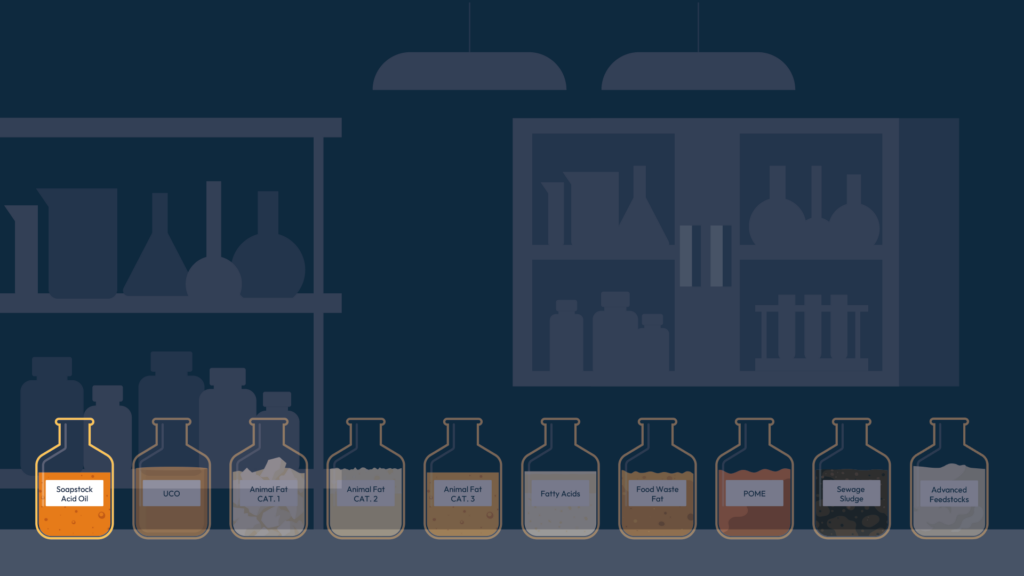
Soapstock Acid (SA) and Soapstock Acid Oil (SAO), but they are not the same material.
Both originate in vegetable oil refining. During the neutralisation stage, crude vegetable oil is treated with an alkaline solution to separate free fatty acids from the oil. These fatty acids form soaps which, together with water and other oil components, create SA.
At this stage, SA is an alkaline emulsion containing free fatty acids, glycerides and a significant amount of water. It is a residue of the refining process, but it is also the starting point for another material with very different characteristics: SAO.
The process changes the material
To turn Soapstock Acid (SA) into Soapstock Acid Oil (SAO), it undergoes acidulation.
Sulphuric acid and high-pressure steam are added to the SA, converting the soaps back into free fatty acids and reducing the material’s emulsifying properties. The acidic water can then be separated, leaving behind SAO, a mixture containing free fatty acids, acylglycerols, pigments and other oil-soluble components.
It sounds like a small step in the wider refining process, but it makes an important difference.
Soapstock acid is a water-rich emulsion. Acidulation separates much of that water and changes the fatty material into a form that can be handled and utilised differently.
One material, several possible routes
Soapstock Acid Oil (SAO) does not have one fixed destination.
Soapstock and its derivatives already have established applications across several industries. They can be used in livestock feed, oleochemical applications and renewable fuels, while SA can also be processed for biogas production. The fatty components can also be used in products such as surfactants, wax esters, plasticisers, and lubricant additives.
For biodiesel production, however, the material requires additional processing. SA typically needs steps such as drying, acidification or hydrolysis before esterification can take place.
This range of applications is precisely what makes the material interesting, and more complex. Understanding where it comes from, how it has been processed and what it contains is essential before determining the most suitable route forward.
Understanding the process before the outlet
For Connex, this is where advanced feedstock knowledge becomes practical.
Understanding Soapstock Acid Oil (SAO) starts with understanding the Soapstock Acid (SA) behind it: how it was generated, how it was processed and what changed during acidulation. Only then can the characteristics of the final material and its possible applications be properly considered.
That is the approach we take with emerging feedstocks: look beyond the product name, understand the process behind the material, and use that knowledge to identify the right route forward.
Because with advanced feedstocks, the difference between two materials can start with one processing step, but that step can change everything.