


Since the beginning of 2025, the European Commission has indicated that new regulations governing UCO imports would be published in June 2025. However, the legislation was not published until October 2025, when Regulation (EU)was introduced. Under the new rules, third-country suppliers of Category 3 used cooking oil (UCO) will be required to obtain veterinary authorisation before exporting to the European Union.
New requirements for third-country UCO suppliers
The regulation is expected to apply from 19 November 2027. In the meantime, national authorities are working on the practical implementation of these requirements. In the Netherlands, implementation is still being discussed with the Dutch Food and Consumer Product Safety Authority (NVWA). It is therefore important to understand the potential implications should these measures come into force as currently envisaged.
What could the new rules mean in practice?
According to an MVO article published on 11 August, the new requirements suggest that third-country suppliers exporting used cooking oil (UCO) to the EU for biofuel production will be required to obtain approval from their national veterinary authorities and be registered in the EU’s TRACES system of authorised establishments.
This requirement suggests that responsibility for TRACES registration will lie with the supplier at origin rather than with the importer (consignee). As a result, imports of UCO may need to be accompanied by a health certificate issued by the competent authorities in the country of origin.
However, it remains unclear whether all UCO imported into the EU will have to be imported as Category 3 animal by-products (ABP) and therefore be subject to the veterinary documentation and checks described above. The regulation should therefore not be interpreted at this stage to mean that all imported UCO will necessarily have to follow the ABP route from 19 November 2027.
One of the stated exemptions applies to UCO derived exclusively from vegetable oils, which could potentially continue to be imported as waste. However, this route has two important disadvantages: waste UCO generally faces higher import duties, depending on the country of origin, and importers would need to demonstrate that the UCO is derived exclusively from vegetable oils. For these reasons, importing UCO as waste is typically not the preferred option.
Europe’s dependence on imported UCO
Based on Eurostat data, the Netherlands, Spain, Belgium, and Italy are among the largest EU importers of Chinese UCO. Year to date, the Netherlands has imported approximately 300 kt of UCO, while Spain has imported around 72 kt and Italy approximately 63 kt, as shown above.
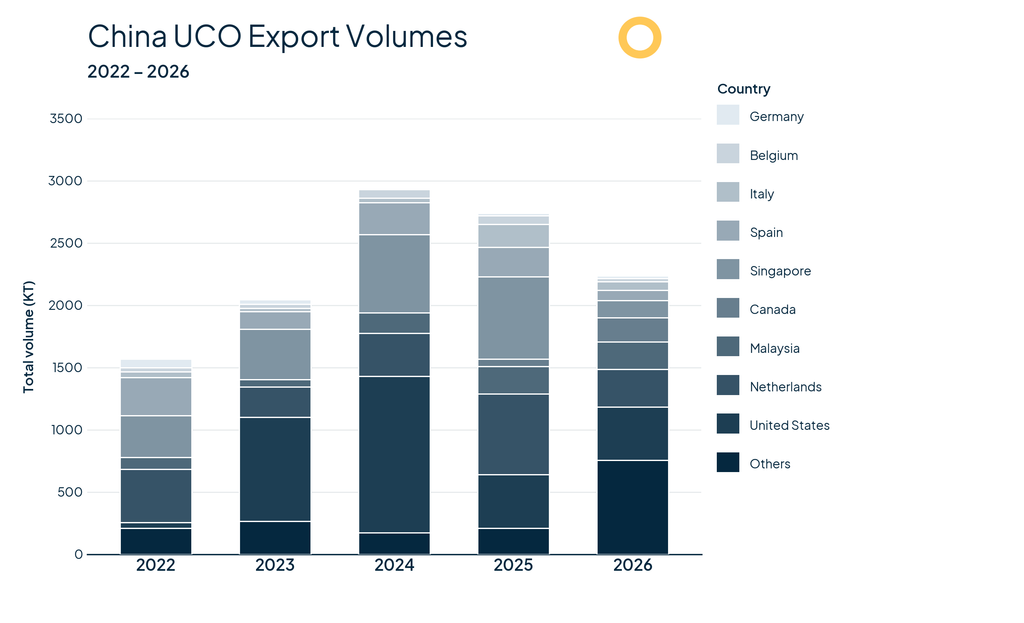
Although not all of these volumes are currently imported as UCO classified as ABP, a preliminary analysis carried out internally at Connex highlights the potential scale of the challenge should health certificates at origin become a requirement. Despite China being the largest supplier of UCO to the EU, Connex’s preliminary analysis found no overlap between Chinese UCO counterparties identified through the ISCC database and the Chinese establishments currently registered in TRACES.
Potential impact on European UCO availability
This apparent gap between the current UCO supply chain and the establishments already registered in TRACES could create challenges if the new requirements are implemented as currently envisaged. Should health certificates at origin become a requirement, ISCC-certified counterparties currently supplying UCO would need to engage with the relevant veterinary authorities in their country to obtain the necessary authorisation.
This could have a significant impact on UCO import availability in Europe. The ability of suppliers to comply with the new requirements will ultimately depend on the situation in each country of origin. If a country is unable to issue the required health certificates, does not have a competent authority able to carry out the authorisation, or if the relevant authority is unwilling to perform this process, affected UCO volumes may no longer be able to enter the European market through the ABP route.
The impact could therefore differ significantly from country to country. Given the EU’s reliance on imported UCO, particularly from China, any difficulties in establishing the required veterinary authorisation and certification processes in major exporting countries could have a substantial impact on UCO supply availability within the European Union.
Connex has raised these potential challenges with MVO, particularly given Europe’s position as a net importer of UCO. If the requirements are implemented as currently envisaged, difficulties in obtaining the necessary approvals and documentation in third countries could put part of Europe’s imported UCO supply at risk, potentially affecting feedstock availability for the European biofuels market at a time when biofuel mandates continue to increase and demand for UCO remains strong due to its availability and favorable sustainability profile.